We present our view of the current global shipbuilding and freight markets, based on the latest available data.
I. Shipbuilding Boom and Asia’s Dominance
In the first half of September, the global shipbuilding industry recorded historically high demand for new vessels, while China maintained its technological dominance. Governments also continued to invest actively in expanding national shipbuilding capacity in response to geopolitical challenges.
Key developments and trends in global shipbuilding
- Orderbooks reach historic levels. According to Clarksons Research, newbuilding activity in 2026 has reached peak levels. Bulk carrier orders are 44% above the ten-year average, while the container ship and gas carrier segments — including LPG and LNG vessels — are demonstrating the highest levels of activity compared with previous records.
- China’s shipbuilding dominance continues. Chinese shipyards have firmly established themselves as the global market leader, securing approximately 75% of worldwide contracted capacity since the beginning of the year. China accounts for 91% of global container ship orders and 90% of bulk carrier orders. Major players, including Hengli Heavy Industries, are actively adopting a “build-before-sale” strategy, even for technically complex LNG carriers.
- Japan seeks to revive its national shipbuilding industry. The Japanese Government has approved a major US$635 million subsidy package for five domestic shipbuilders, including Mitsubishi Shipbuilding, which will receive US$260 million, and Shin Kurushima Group, which will receive US$208 million. The investment is intended to expand shipyard capacity for the construction of next-generation LNG carriers and restore market share lost to China’s shipbuilding industry.
- Advanced technologies strengthen South Korea’s position. South Korean shipbuilders remain highly competitive in the construction of technologically advanced vessels, holding 65% of the global LPG carrier market and 59% of the LNG carrier market.
- Smart shipbuilding standards are being developed. The American Bureau of Shipping (ABS) has signed a memorandum of understanding with the Korea Marine Equipment Research Institute (KOMERI). The initiative aims to promote the international standardisation of smart-ship and digital shipyard technologies, helping to reduce barriers for Korean marine-equipment manufacturers entering overseas markets.
- Key outcomes of SMM 2026. At the beginning of September, Hamburg hosted SMM, the world’s leading maritime exhibition. The main topics of discussion included fleet decarbonisation, the transition to alternative fuels, and new challenges facing shipbuilding as a result of rising freight rates and the need to avoid high-risk geopolitical areas such as the Red Sea.
II. Freight Market: Anomalous Surge in Revenues
The global shipping market presented a contrasting picture in the first half of September: exceptionally high profits against the backdrop of geopolitical crises, the accelerated transition to alternative fuels and increasing competition for control over key trade routes.
Key developments and trends in international shipping
- Container shipping boom. Container freight rates remain at record levels. The prolonged Red Sea crisis and the diversion of vessels around the Cape of Good Hope have intensified the shortage of available tonnage. Major carriers, including MSC, Maersk and CMA CGM, are reporting substantial increases in operating profits.
- Increase in blank sailings. To prevent spot rates from falling as new vessels enter service, carrier alliances cancelled a number of services on Asia–Europe and Asia–US routes during the first half of September, artificially restricting available capacity.
- The Red Sea remains effectively blocked. As of September, traffic through the Suez Canal remained more than 60% below pre-crisis levels. Shipowners have now incorporated the long-term costs of the alternative route around Africa — adding 10 to 14 days to a voyage — into their budgets.
- Restrictions on shipping through the Panama Canal. Although hydrological conditions in the Panama Canal have improved, the Canal administration continues to impose strict auction quotas for the passage of large vessels. This forces LNG carrier and bulk carrier operators to select longer routes.
- Green fuels remain a point of tension between Europe and Asia. During the first half of September, shipowners continued to take different positions on investment in green fleets. Maersk, on the one hand, continued to introduce large container ships powered by green methanol. Japanese and Singaporean operators, on the other, began placing test orders for ammonia-ready vessels, despite ammonia’s high toxicity.
- Growing environmental pressure from European regulators. The European Union Emissions Trading System (EU ETS) is encouraging shipowners calling at EU ports to optimise vessel speed through slow steaming. This is intended to reduce their carbon footprint and avoid substantial financial penalties.
- Major alliances are being reshaped. Ahead of the formal dissolution of the 2M alliance in early 2027, Maersk and Hapag-Lloyd have approved the operational plans for their new Gemini Cooperation. During the first half of September, they presented an updated hub network and pledged schedule reliability of more than 90%.
- Global maritime logistics continues to consolidate. MSC, the market leader, continued to acquire port terminals and logistics assets around the world, with the aim of becoming a fully integrated operator independent of third-party providers.
III. Impact of Global Developments on Russia’s Maritime Industry
For Russia, global trends in shipbuilding and shipping in September are creating both unique opportunities — particularly by increasing demand for the country’s geographical advantages — and additional pressure on long-standing challenges in logistics and import substitution.
International developments in the first half of September affected Russia’s maritime industry in several key areas:
- The Northern Sea Route reaches a defining moment. Against the backdrop of disruption in the Suez Canal, the Northern Sea Route is becoming a strategically important commercial corridor. The first half of September saw a sharp increase in interest from Asian companies. For example, South Korea’s PanStar Group officially announced plans to expand its container shipping operations along the Northern Sea Route.
- Russian shipyards face mounting pressure. According to Russian industry experts, more than 320 vessels are currently under construction at Russian shipyards. The Government is providing substantial subsidies for the construction of river–sea vessels and scrappage grants. However, delivery schedules are being delayed following the withdrawal of Western equipment suppliers. At the same time, civil shipbuilding remains highly dependent on imported components, particularly heavy-duty diesel engines and propulsion systems.
- The Korean factor and rising freight costs. South Korea’s dominance in the LNG carrier segment continues to complicate Russian Arctic projects. Under sanctions pressure, Korean shipyards are blocking the transfer of completed ice-class tankers. At the same time, the overall overheating of the freight market is directly affecting the cost of servicing Russian exports. Due to sanctions, Russia is relying increasingly on the so-called “shadow fleet” of tankers and bulk carriers. As global shipowners generate exceptional profits on diverted routes, the cost of chartering vessels to transport Russian oil and grain is also rising significantly.
The data and analysis were prepared by the Programme Department of the NEVA Exhibition.
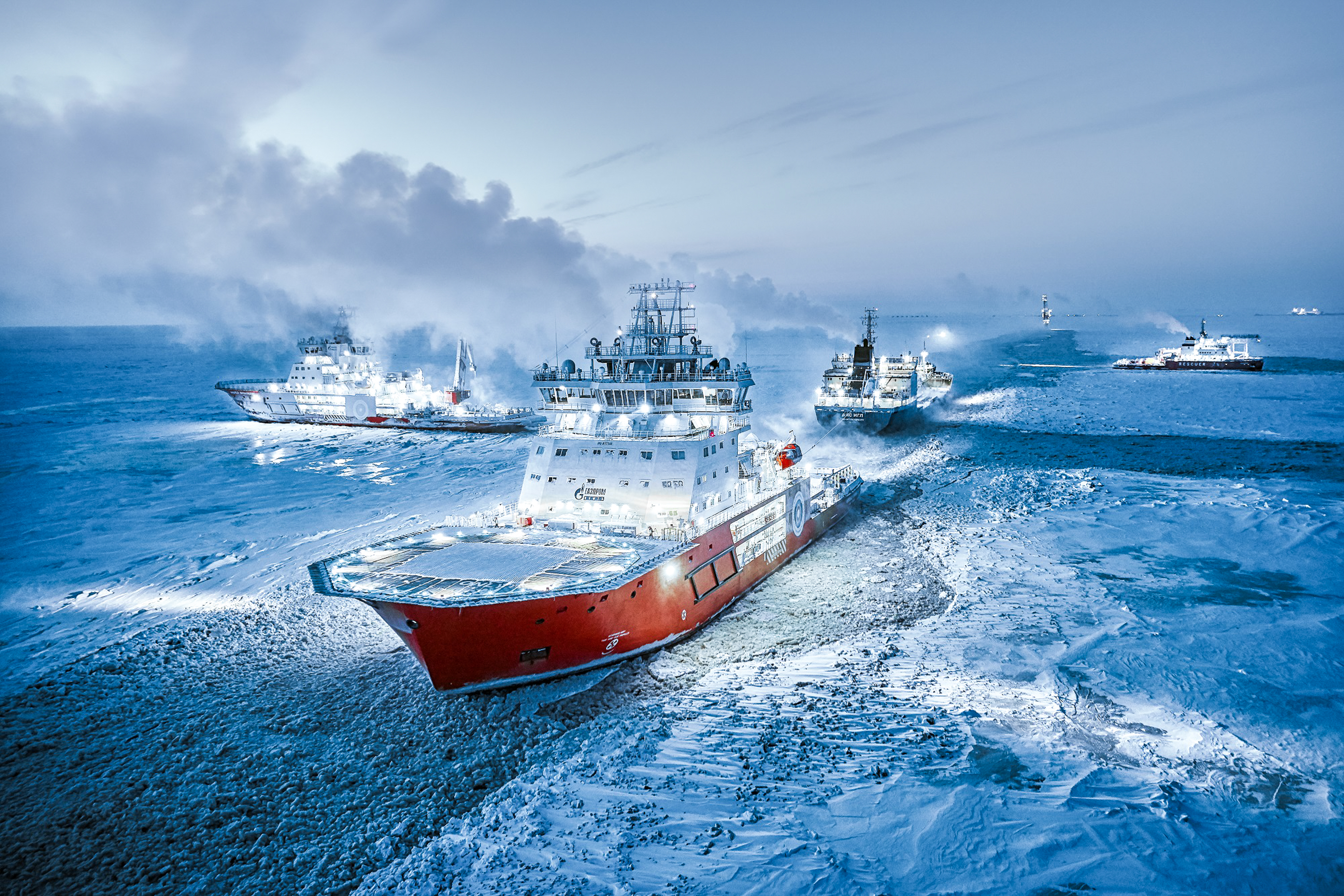
Photo: PJSC Gazprom Neft (used under an open license).


